
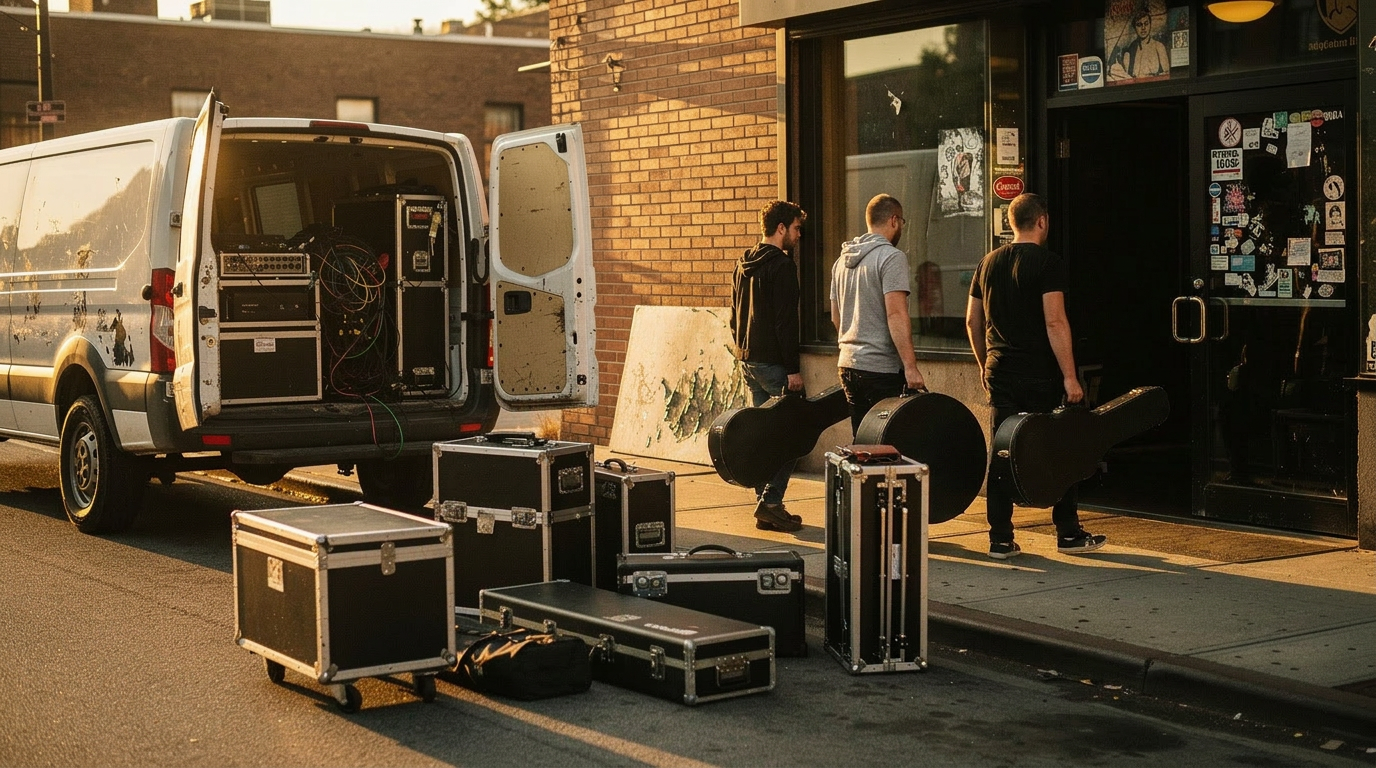
It's 3pm on a show day and your phone buzzes. It's the bass player. "Hey, what time's load-in again?"
You already told him. Twice. It was in the group text last Tuesday, buried now under a hundred messages about where to eat and a video somebody's cousin posted. So you type it out one more time. Then the drummer asks. Then someone shows up at 6:30 for a 5:30 load-in, soundcheck runs late, the sound guy's already irritated, and the whole night starts a step behind before you've played a note.
Every gigging band knows this dance. It's not that your bandmates don't care. It's that the call time lives in the wrong place.
The times that make or break a night
A show isn't one time on the calendar. It's a stack of them.
Load-in. Soundcheck. When to actually meet up. Sometimes a separate address for gear versus parking. Downbeat. Each one depends on the one before it, so when a single person misses a single time, it cascades into everyone standing around waiting, or scrambling, or apologizing to the venue.
The band leaders who never seem to deal with this aren't more organized people by nature. They just run a few simple habits every single show. Here's what those habits look like.
Work backward from downbeat
Don't pick a load-in time out of thin air. Start from when you hit the first note and subtract what has to happen at the venue before it: soundcheck, setup, and hauling the gear in from the vehicle. What's left is your load-in time, the moment the whole band needs to be at the venue ready to work. If you're carpooling, back the drive time out from there too, so you know when and where to meet up. Most day-of rushing traces back to a load-in time that was a guess instead of a calculation.
Ask the venue before you set anything
Your times depend on theirs. Before you tell the band a single thing, find out when you can actually get into the room, whether soundcheck happens before or after doors, and where to park and unload. A surprising amount of show-day chaos is just a band setting its own schedule without asking the venue one question.
There's a bigger payoff here than a smooth night. When you ask about the venue's timeline and then actually respect it, you're showing the owner and the sound guy that you're easy to work with. The bands that hit their load-in, don't hold up soundcheck, and don't leave the staff waiting are the ones that get invited back, over and over. Punctuality is part of being bookable.
Build in a buffer
Something always seems to happen. Traffic, a forgotten cable, the member who is reliably ten minutes behind. Pad your load-in by fifteen or twenty minutes so the slack is already baked in. Plenty of seasoned band leaders quietly set the official call time a touch earlier than they truly need, because they know how their people run.
This is another place knowing the venue pays off. Load-in at one room might be ten feet from the stage. At another, it's a winding loading dock, a freight elevator, and parking two blocks away before you set down a single piece of gear. Same equipment, wildly different amount of time. Once you've played a room, you know exactly how much buffer it really needs.
Standardize your rhythms
Notice that's plural. There's no single magic schedule, because every show hands you a different setup. Is the venue providing sound, or are you bringing the PA and running it yourself? Are the lights handled, or are you hauling in your own rig? A plug-and-play gig where the house covers sound and lights might run load-in two hours before doors and soundcheck ninety minutes before. A full-production night where you build everything from scratch can need an extra hour or more on the front end.
So establish a few standard rhythms, one for each situation you regularly run into, and know exactly how long setup takes in each. Once you've asked the venue what they provide, you'll already know which rhythm you're on and what load-in needs to be. When your patterns are consistent, people internalize them and stop asking. Predictable beats memorable.
Confirm the night before, not the day of
A quick note the evening before does more than a dozen day-of texts. "Load-in's at five tomorrow, meet at the back door." Sending that the night before catches the conflict while there's still time to solve it. The day-of scramble is almost always a day-before conversation that never happened.
And confirm both ways. A quick message to the venue the day before, making sure nothing's shifted on their end, matters as much as the one to your band. That's really what all of this comes down to: communication, with your bandmates and with the venue and sound guy alike. Keep both sides of the stage on the same page, and most of the day-of chaos never gets started.
Give the plan a home, and a nudge
This is the one most bands get wrong, and it's the whole ballgame. Once you've nailed down the times, they have to live in one place everyone actually trusts, and something has to remind people before it matters. Not because your band is disorganized, but because a call time announced once in a group text is a call time that's already half-forgotten.
Think about how you keep track of your own life. The dentist, the kid's game, the work meeting. It's in your calendar, and your phone taps you on the shoulder before it happens. You don't count on someone texting you an hour ahead. Your band's call times deserve the same treatment: in everyone's calendar, with a reminder attached, updating themselves when something changes. Stop telling people the times. Start getting the times onto their schedule.
One clean way to make it automatic
You can absolutely pull this off with a shared calendar and a little discipline, and plenty of bands do. Where BandTopia helps is taking the discipline out of it. You set the load-in, soundcheck, meet-up, and any other call time once, and each member subscribes so those times flow straight into the calendar they already use, Apple or Google. They can show up as their own separate entries, each with its own address if load-in and parking are in different spots, and they update for everyone automatically when something moves. Now that BandTopia's on iPhone and Android, it's right there in your pocket next to the calendar app you open ten times a day.
But the tool matters less than the habit. Whatever you use, the goal is the same: put the times where people already look, and let something other than your own memory do the reminding.
Stop being the human reminder
You didn't start a band to spend show day answering the same question five times.
The night runs smoother when everyone shows up at the right time to the right place, and that comes down to a few repeatable habits: work backward from downbeat, ask the venue, build in a buffer, keep your rhythms consistent, confirm the night before, and give the plan a home that reminds people on its own. Do that, and load-in stops being a thing you manage and starts being a thing that just happens. Then you can go focus on the part you actually signed up for, which is the show.
Want your whole band on the same schedule without riding anybody? Start free at bandtopia.io.